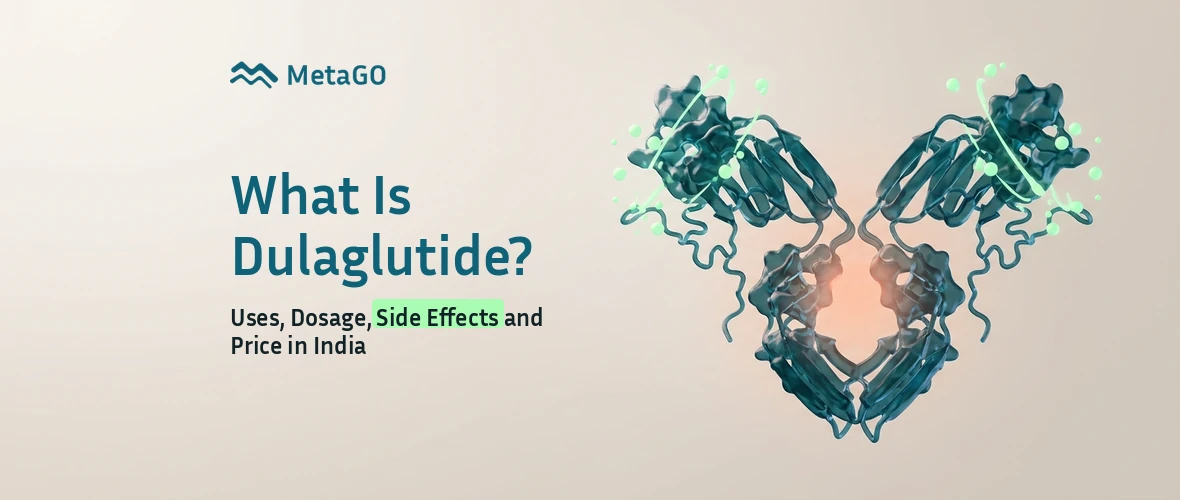
Translucent 3D dulaglutide Fc-fusion peptide with mint binding particles, uses dosage price India

Table of Contents

What Is Dulaglutide? A Complete Guide to Uses, Dosage, and Side Effects

Medical Disclaimer: This article is for informational purposes only and does not constitute medical advice. Always consult a qualified healthcare professional before starting, changing, or stopping any medication.<\/em><\/td><\/tr><\/tbody><\/table><\/figure>
Key Takeaways<\/strong><\/td><\/tr>
•  Dulaglutide (brand name: Trulicity) is a once-weekly injectable GLP-1 receptor agonist approved for type 2 diabetes management and cardiovascular risk reduction.<\/td><\/tr>
•  The REWIND trial found a 12% reduction in major cardiovascular events and a 15% reduction in composite renal outcomes over 5.4 years.<\/td><\/tr>
•  Common side effects include nausea, diarrhea, and vomiting, especially in the first weeks. Serious side effects are less common but require prompt attention.<\/td><\/tr><\/tbody><\/table><\/figure>

If your doctor has prescribed dulaglutide, or is considering it as part of your diabetes care.<\/p>

This guide covers exactly what it is, how it works, what the clinical evidence shows, and what you need to know before and during treatment.<\/p>

1. What Exactly Is Dulaglutide (Trulicity)?<\/strong><\/h2>

Dulaglutide is the generic name<\/strong> for the prescription injectable medication marketed under the brand name Trulicity<\/strong>, manufactured by Eli Lilly and Company. <\/p>

It belongs to a class of medications called glucagon-like peptide-1 (GLP-1) receptor agonists<\/strong>, which work by mimicking a naturally occurring gut hormone.<\/p>

The U.S. Food and Drug Administration (FDA)<\/a> first approved dulaglutide in September 2014<\/strong> for adults with type 2 diabetes. <\/p>

A 2022 regulatory review confirmed its use in children and adolescents 10 years of age and older<\/strong> with type 2 diabetes.<\/p>

It is not insulin. Dulaglutide does not introduce insulin into the body. Instead, it stimulates the pancreas to produce its own insulin when blood sugar rises, while also reducing signals that push blood sugar higher.<\/p>

In India, Trulicity<\/a> is available as a prescription-only medication, primarily through hospital pharmacies and specialist practices, typically under the supervision of an endocrinologist or diabetologist.<\/p>

Quick Facts<\/strong><\/th>Details<\/strong><\/th><\/tr><\/thead>
Generic name<\/td>Dulaglutide<\/td><\/tr>
Brand name<\/td>Trulicity<\/td><\/tr>
Manufacturer<\/td>Eli Lilly and Company<\/td><\/tr>
Drug class<\/td>GLP-1 receptor agonist (incretin mimetic)<\/td><\/tr>
FDA approval (Type 2 Diabetes)<\/td>September 2014<\/td><\/tr>
FDA approval (Cardiovascular Risk Reduction)<\/td>2020<\/td><\/tr>
Dosing frequency<\/td>Once weekly (subcutaneous injection)<\/td><\/tr>
Available doses<\/td>0.75 mg, 1.5 mg, 3 mg, 4.5 mg per 0.5 mL single-dose pen<\/td><\/tr>
Available in India<\/td>Yes, as Trulicity (prescription required)<\/td><\/tr><\/tbody><\/table><\/figure>

2. How Does Dulaglutide Work Inside the Body?<\/strong><\/h2>

To understand how dulaglutide works, it helps to start with GLP-1 (glucagon-like peptide-1)<\/strong>: a hormone your intestines release naturally after a meal. <\/p>

It signals the pancreas to release insulin, tells the liver to slow glucose production, and sends fullness signals to the brain.<\/p>

In people with type 2 diabetes, this system does not function efficiently enough. Dulaglutide steps in by mimicking GLP-1 at the receptor level, amplifying these signals for a full seven days with each single dose.<\/p>

The Three Core Mechanisms<\/strong><\/h3>

1. Glucose-dependent insulin release: <\/strong>Dulaglutide activates GLP-1 receptors on pancreatic beta cells, triggering insulin secretion. This process only occurs when blood glucose is already elevated, which is why the risk of hypoglycemia is significantly lower<\/strong> compared to traditional insulin or sulfonylurea therapy when dulaglutide is used on its own.<\/p>

2. Glucagon suppression: <\/strong>Dulaglutide reduces glucagon, a hormone that signals the liver to release stored glucose into the bloodstream. Lower glucagon levels mean lower fasting and post-meal blood sugar.<\/p>

3. Slowed gastric emptying: <\/strong>Food moves more slowly through the stomach, flattening sharp blood sugar spikes after meals. This also contributes to a feeling of fullness, which may reduce overall calorie intake in many patients.<\/p>

What Is Dulaglutide Actually Made Of?<\/strong><\/h3>

Dulaglutide is a biosynthetic fusion protein<\/strong>, engineered from two identical GLP-1 analogue chains, each linked to a modified human immunoglobulin G4 (IgG4) antibody fragment via a small peptide connector. <\/p>

According to the FDA prescribing information<\/a>, it shares 90% amino acid sequence homology<\/strong> with endogenous human GLP-1. This molecular design extends its half-life to approximately 5 days<\/strong>, making once-weekly dosing both practical and effective. <\/p>

The medication is produced using mammalian cell cultures through recombinant DNA technology.<\/p>

3. What Is Dulaglutide Approved to Treat?<\/strong><\/h2>

Dulaglutide has two distinct FDA-approved indications. Understanding both matters for patients and caregivers.<\/p>

Primary Indication: Type 2 Diabetes Management<\/strong><\/h3>

Dulaglutide is approved as an adjunct to diet and exercise<\/strong> to improve glycemic control in adults and children aged 10 and older with type 2 diabetes mellitus<\/strong>. <\/p>

It may be used alone (monotherapy) or in combination with other anti-diabetes medications including metformin, sulfonylureas, and insulin.<\/p>

It is not approved for type 1 diabetes. It should not be used for diabetic ketoacidosis.<\/p>

Second Indication: Cardiovascular Risk Reduction<\/strong><\/h3>

In 2020<\/strong>, the FDA approved dulaglutide to reduce the risk of major adverse cardiovascular events (MACE)<\/strong> in adults with type 2 diabetes who have established cardiovascular disease or multiple cardiovascular risk factors. <\/p>

This made dulaglutide the first GLP-1 receptor agonist<\/strong> with an approved indication for both primary and secondary cardiovascular prevention in this population.<\/p>

This approval was built on the landmark REWIND (Researching cardiovascular Events with a Weekly INcretin in Diabetes) trial<\/em>, published in The Lancet<\/em> in 2019, and is discussed in detail in Section 4.<\/p>

Regarding weight: dulaglutide is not FDA-approved as a weight loss medication. Modest weight reduction is a recognized secondary effect in many patients using it for diabetes, which is discussed further in Section 8.
<\/p>

4. What Does the Clinical Evidence Show?<\/strong><\/h2>

Dulaglutide is among the most thoroughly studied medications in the GLP-1 class. Here is a focused summary of the major trials.<\/p>

Blood Sugar Control: The AWARD Trial Program<\/strong><\/h3>

The AWARD (Assessment of Weekly Administration of LY2189265 [dulaglutide] in Diabetes)<\/em> trial program comprised multiple phase 3 studies across more than 3,342 patients<\/strong>. <\/p>

Across these trials, dulaglutide consistently reduced HbA1c from baseline in a dose-dependent manner.<\/p>

Dulaglutide Dose<\/strong><\/th>Mean HbA1c Reduction<\/strong><\/th>Mean Weight Change at 36 Weeks<\/strong><\/th><\/tr><\/thead>
0.75 mg\/week<\/td>Approx. 1.0%<\/td>Approx. -1.5 to -2.3 kg<\/td><\/tr>
1.5 mg\/week<\/td>Approx. 1.1% to 1.5%<\/td>Approx. -2.3 to -3.0 kg<\/td><\/tr>
3.0 mg\/week<\/td>Approx. 1.5% to 2.5%*<\/td>Approx. -4.0 kg*<\/td><\/tr>
4.5 mg\/week<\/td>Approx. 1.7% to 3.2%*<\/td>Approx. -4.7 kg*<\/td><\/tr><\/tbody><\/table><\/figure>

*Data from the AWARD-11 trial<\/a> (N=1,842), published in Diabetes Care<\/em>, 2021. The 4.5 mg dose produced superior HbA1c reductions versus 1.5 mg at 36 weeks (ETD: -0.24%, p<0.001).<\/p>

Heart Health: The REWIND Trial<\/strong><\/h3>

The REWIND trial<\/em> enrolled 9,901 participants<\/strong> across 371 sites in 24 countries<\/strong>, followed over a median of 5.4 years<\/strong>. <\/p>

Critically, approximately two-thirds of participants had no prior cardiovascular event and were enrolled based on cardiovascular risk factors alone, making this one of the broadest cardiovascular outcome trials conducted for a GLP-1 medication.<\/p>

Key findings, published in The Lancet (2019)<\/a>:<\/p>