
A deep dive into one of India’s fastest-growing metabolic epidemics, and the science-backed strategies that can help reverse it.
Insulin resistance is no longer just a term that endocrinologists throw around in consultation rooms.
It is quietly becoming the defining metabolic challenge for millions of Indians, and the troubling part is that most people have no idea it is happening until significant damage is already done.
Stubborn belly fat that refuses to budge despite dieting. Extreme fatigue after meals. Intense sugar cravings that feel impossible to ignore.
These are not just signs of a busy, high-stress schedule. They are often early red flags of insulin resistance, a condition that sits at the root of type 2 diabetes, PCOS, fatty liver disease, and metabolic syndrome.
According to the ICMR-INDIAB national cross-sectional study published in The Lancet Diabetes and Endocrinology in 2023, India is now home to 101 million people living with diabetes and a staggering 136 million with prediabetes. At the core of most of these cases? Insulin resistance.
This article breaks down why Indians are disproportionately vulnerable, how to identify the condition early, and what treatment options, including newer GLP-1 receptor agonists, are now changing outcomes for patients across India.
So, What Exactly Is Insulin Resistance?
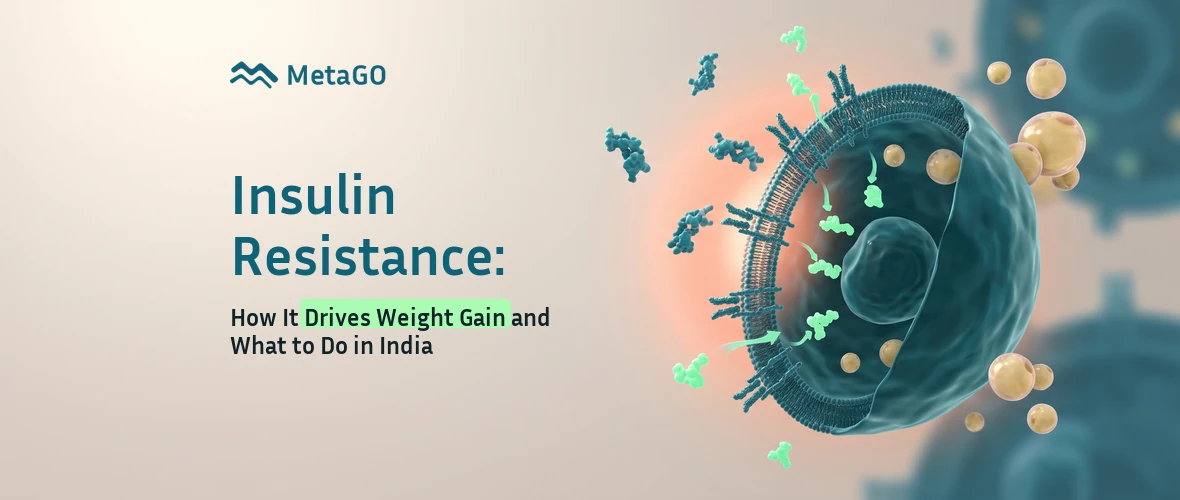
Think of insulin as a key and your body’s cells as locked doors. When you eat, glucose enters your bloodstream. Insulin is released by the pancreas to “unlock” cells, allowing glucose to enter and be used for energy.
Insulin resistance happens when those locks stop responding properly. The cells no longer open efficiently in response to insulin’s signal. Glucose stays stuck in the bloodstream. Your pancreas, trying to compensate, pumps out more and more insulin.
For a while, it manages. But over time, the pancreas tires, blood sugar rises, and the metabolic system begins to break down.
The key fact: Chronically elevated insulin levels actively signal your body to store fat, especially around the abdomen, making weight gain a direct consequence of untreated insulin resistance, not a separate problem.
This is why insulin resistance and weight gain are so tightly linked. It is not simply about calories in and calories out. It is about a hormonal environment that makes fat storage the path of least resistance for your body.
Why Are Indians Especially at Risk?
This is not a perception. It is well-documented in research. Indians and other South Asians develop insulin resistance and type 2 diabetes at significantly lower body weights and younger ages compared to Western populations.
The Body Composition Factor
Research published in the Journal of Clinical Endocrinology and Metabolism by Misra et al. demonstrated that Indians have a higher percentage of body fat, particularly visceral (abdominal) fat, at any given BMI compared to people of European descent.
This visceral fat is metabolically active and releases inflammatory molecules that directly impair insulin signaling.
The WHO Expert Consultation published in The Lancet in 2004 formally established lower BMI thresholds for Asian populations: overweight is defined as BMI 23 kg/m² or above for Indians (compared to 25 for Western populations) precisely because of this metabolic risk profile.
The Dietary Pattern
Traditional Indian diets are rich in carbohydrates, from rice and wheat-based rotis to sweetened chai, fruit juices, and biscuits consumed across the day.
While these foods are deeply cultural and not inherently harmful in moderation, the quantity and frequency of refined carbohydrate consumption creates sustained insulin spikes throughout the day.
Add to this a general underemphasis on dietary protein and healthy fats, and the metabolic picture becomes clearer.
The Sedentary Shift
Long commutes, desk-based work, screen-heavy leisure, and compressed schedules have dramatically reduced incidental physical activity for a large proportion of working-age Indians. Skeletal muscle is the largest glucose sink in the body.
When muscles are underused, their insulin sensitivity drops, worsening the overall metabolic picture.
The Genetic Predisposition
The Chennai Urban Rural Epidemiology Study (CURES-10) followed participants for 10 years and found that Asian Indians progress from prediabetes to type 2 diabetes faster and at younger ages than other ethnic groups, suggesting a genetic component to impaired insulin secretion and sensitivity that operates independently of lifestyle factors.
Are You Insulin Resistant? Here Are the Signs to Watch For
Insulin resistance rarely arrives with a dramatic announcement. It builds gradually, often for years, with symptoms that are easy to dismiss as simply “being tired” or “needing to eat better.”
Common Symptoms
- Persistent weight gain around the abdomen, even without significant changes in diet
- Intense carbohydrate or sugar cravings, especially after meals
- Energy crashes in the mid-afternoon or after eating
- Acanthosis nigricans: dark, velvety patches of skin at the back of the neck, underarms, or groin (a direct sign of high insulin levels)
- Elevated fasting triglycerides and low HDL cholesterol on a lipid panel
- PCOS (polycystic ovarian syndrome) in women, which is strongly driven by insulin resistance
- Brain fog, difficulty concentrating, or poor memory
- Feeling hungry again within 2 hours of a full meal
How Is It Diagnosed in India?
Insulin resistance does not have a single universally accepted test, but Indian clinicians typically use a combination of the following:
- Fasting insulin levels (optimal: below 10 mIU/L; levels above 15 mIU/L typically indicate resistance)
- HOMA-IR score (Homeostatic Model Assessment of Insulin Resistance): calculated from fasting glucose and fasting insulin; a score above 2.5 is considered abnormal in Indian populations
- HbA1c and fasting plasma glucose to assess blood sugar control
- Lipid profile with particular focus on the triglyceride-to-HDL ratio
- Oral Glucose Tolerance Test (OGTT) for a more comprehensive view of glucose metabolism
A note for Indian readers: Screening is recommended from age 25 onwards (or earlier with a family history of diabetes or PCOS) due to the earlier onset seen in Indian populations, as supported by the ICMR-INDIAB data.
The Weight Gain Trap: Why Insulin Resistance Makes It So Hard to Lose Weight
This is the question most people really want answered. Why, despite cutting calories, skipping meals, and exercising occasionally, does the weight simply not move?
The answer lies in the hormonal environment created by insulin resistance. When insulin levels are chronically high, two things happen simultaneously:
- Fat burning is blocked: Elevated insulin actively suppresses lipolysis, the process by which your body breaks down stored fat for energy. You simply cannot burn fat efficiently when insulin is high.
- Fat storage is accelerated: High insulin drives glucose into fat cells (adipocytes), where it is stored as triglycerides. This is especially pronounced around the abdomen.
To make matters worse, a high-carbohydrate diet, which is common in Indian dietary patterns, keeps insulin levels elevated for much of the day.
This creates a cycle where fat burning is perpetually suppressed, hunger signals are dysregulated, and the body resists any meaningful weight loss.
For many people with insulin resistance, conventional advice such as “eat less, move more” fails not because they are not trying hard enough, but because the underlying hormonal driver has not been addressed.
What Actually Works: Insulin Resistance Treatment in India
1. Diet: The Most Powerful Intervention You Can Start Today
Dietary modification is the most impactful, fastest-acting, and most evidence-supported first step.
The goal is not extreme restriction; it is strategic carbohydrate management combined with adequate protein and healthy fat.
Insulin Resistance Diet Principles for India
- Replace refined carbohydrates with complex alternatives: Swap white rice for smaller portions of millets (ragi, jowar, bajra), which have a lower glycaemic index and higher fibre content.
- Prioritise protein at every meal: Dal, eggs, paneer, low-fat curd, lean chicken, and fish all help stabilize blood sugar and reduce insulin spikes after meals.
- Increase dietary fibre: Non-starchy vegetables, legumes, and whole seeds like psyllium husk slow glucose absorption and blunt insulin response.
- Include healthy fats: Moderate use of ghee, coconut, nuts, and seeds supports satiety and does not spike insulin.
- Eliminate liquid calories: Sweetened chai, fruit juices, packaged drinks, and even “healthy” smoothies deliver rapid glucose loads and should be minimised.
- Time your eating: Eating within a defined window (for example, an 8-to-10-hour window) allows insulin levels to fall during the fasting period, enabling fat burning to occur.
The Indian Diabetes Prevention Programme (IDPP-1), published in Diabetologia exercised lifestyle modification reduced the progression from prediabetes to type 2 diabetes by 28.5% over three years, an effect comparable to that of metformin, achieved through diet and activity changes alone.
2. Exercise: Your Body’s Natural Insulin Sensitiser
Physical activity acts as a direct, medication-free mechanism for improving insulin sensitivity. Skeletal muscle contraction activates glucose transporters (GLUT4) independent of insulin, bypassing the resistance and pulling glucose out of the blood.
- Aerobic exercise: A brisk 30-minute walk, cycling, swimming, or any sustained cardio activity performed most days of the week significantly lowers fasting insulin levels over time.
- Resistance training: Building muscle mass creates more glucose-storing tissue and is particularly powerful for long-term insulin sensitivity. Even 2 to 3 sessions of strength training per week makes a measurable difference.
- Post-meal walking: A 10-to-15-minute walk after meals substantially reduces post-meal blood glucose spikes and has become one of the most-recommended lifestyle tweaks for insulin-resistant individuals.
Research consistently shows that combining aerobic exercise with resistance training produces the greatest improvements in both insulin sensitivity and body composition, particularly visceral fat reduction, which is the most metabolically harmful form.
Metformin: The Trusted First-Line Medication for Insulin Resistance
Metformin has been the gold standard pharmacological treatment for insulin resistance and type 2 diabetes prevention for decades.
It is safe, well-studied, widely available across Indian pharmacies, and listed on the WHO’s Essential Medicines List.
How Does Metformin Work?
- Reduces glucose production by the liver (hepatic gluconeogenesis)
- Improves the cells’ sensitivity to insulin
- Lowers fasting blood glucose levels
- Modest impact on body weight (stabilisation rather than significant loss)
The landmark Diabetes Prevention Program (DPP) study, published in the New England Journal of Medicine, demonstrated that metformin reduced the risk of developing type 2 diabetes in high-risk individuals by 31% over approximately 3 years.
This established its role not just in treating diabetes, but in preventing it.
The IDPP-1 study further validated this in an Indian population context, showing that metformin produced a 26.4% relative risk reduction in progression to diabetes among Indian participants with impaired glucose tolerance.
Limitations of Metformin
While metformin is an excellent first-line agent, it has meaningful limitations for a significant subset of patients with insulin resistance:
- It does not produce substantial weight loss, which is a significant gap when obesity is driving the insulin resistance
- Some patients experience persistent GI side effects including nausea, bloating, and diarrhoea
- It does not address appetite dysregulation, the powerful hunger drive that comes with insulin resistance
- It offers limited cardiovascular benefit compared to newer drug classes
For patients who need meaningful weight reduction alongside insulin resistance treatment, the emergence of GLP-1 receptor agonists has transformed clinical possibilities.
GLP-1 Receptor Agonists: The Science That Is Changing How We Treat Insulin Resistance
GLP-1 (Glucagon-Like Peptide-1) receptor agonists are among the most significant advances in metabolic medicine in the last two decades.
Originally developed for type 2 diabetes, their effects on insulin resistance, body weight, and cardiovascular health have been so substantial that they are reshaping treatment guidelines globally.
How Do GLP-1 Agonists Work?
GLP-1 is a natural gut hormone secreted after eating. GLP-1 receptor agonists are synthetic molecules that mimic this hormone and amplify its effects:
- Stimulate insulin release in a glucose-dependent manner (insulin is only released when blood sugar is actually elevated, reducing hypoglycaemia risk)
- Suppress glucagon, the hormone that tells the liver to release stored glucose
- Slow gastric emptying, meaning food is absorbed more slowly and you feel full for longer
- Act directly on the hypothalamus in the brain to reduce appetite and food-seeking behaviour
- Improve beta-cell function in the pancreas over time
- Demonstrated direct anti-inflammatory effects on visceral fat tissue
What Does the Research Show?
The STEP 1 trial (Semaglutide Treatment Effect in People with Obesity), published in the New England Journal of Medicine in 2021, is perhaps the most cited study in this space.
Participants on once-weekly semaglutide achieved a mean body weight reduction of 14.9% over 68 weeks, alongside significant improvements in insulin sensitivity, blood pressure, triglycerides, and HDL cholesterol.
The SUSTAIN-6 trial, also in the New England Journal of Medicine, demonstrated that semaglutide reduced major adverse cardiovascular events (heart attack, stroke, cardiovascular death) by 26% in patients with type 2 diabetes and high cardiovascular risk.
This cardiovascular benefit is now a critical consideration when selecting treatment for insulin-resistant patients with metabolic syndrome.
The STEP 2 trial published in The Lancet in 2021, specifically examined semaglutide in patients with type 2 diabetes and overweight or obesity, finding 9.6% mean weight reduction alongside meaningful improvements in glycaemic control, confirming the drug’s dual role in both insulin resistance and body weight management.
GLP-1 Options in India: What Is Currently Available?
GLP-1 receptor agonists are now available in India, though their reach is still predominantly through specialist care. Here is what patients and clinicians need to know:
Semaglutide (Ozempic and Wegovy)
Semaglutide, the active compound behind Ozempic (approved for type 2 diabetes management) and Wegovy (approved specifically for weight management), has received regulatory clearance from India’s Central Drugs Standard Control Organisation (CDSCO) for its diabetes indication.
Access and availability continue to expand as distribution logistics improve across major Indian cities.
Indian pharmaceutical manufacturers are also in active development of generic and biosimilar semaglutide formulations, which are expected to significantly improve accessibility.
Liraglutide (Victoza and Saxenda)
Liraglutide (once-daily injection) is approved and available in India for type 2 diabetes management.
Clinical trial data has consistently demonstrated significant benefits for both insulin resistance and weight reduction.
Dulaglutide (Trulicity)
Dulaglutide (once-weekly injection) is available in India with well-established evidence for insulin resistance management, glycaemic control, and cardiovascular risk reduction.
Important: GLP-1 receptor agonists in India are currently prescribed primarily through endocrinologists and diabetologists. Patients should not seek these medications without a formal medical evaluation, as dosing, monitoring, and contraindication assessment are essential.
Metformin vs. GLP-1 Agonists: Which Is Right for You?
Both drug classes are valuable tools in managing insulin resistance, and for many patients, the most effective approach involves using both together.
Here is how they compare across key dimensions:
| Feature | Metformin | GLP-1 Receptor Agonists |
|---|---|---|
| Mechanism | Reduces liver glucose output; improves insulin sensitivity | Mimics gut GLP-1 hormone; reduces appetite and slows digestion |
| Weight Effect | Modest weight stabilization | Significant weight loss (10–15% of body weight) |
| Cardiovascular Benefit | Neutral to modest benefit | Proven reduction in major cardiovascular events |
| Administration | Oral tablet (once to three times daily) | Injectable (once weekly or once daily depending on type) |
| Common Side Effects | GI discomfort, nausea (usually early and transient) | Nausea, vomiting (typically early and self-limiting) |
| Best Suited For | Early insulin resistance; diabetes prevention | Insulin resistance with obesity or elevated cardiovascular risk |
The right choice depends on the individual’s metabolic profile, degree of insulin resistance, cardiovascular risk, weight goals, and response to treatment.
A combination approach, using metformin as the foundation with a GLP-1 agonist added when weight or cardiovascular risk is significant, is increasingly supported by international guidelines and is being adopted by Indian endocrinologists.
The Bigger Picture: Can India Reverse This Epidemic?
The ICMR-INDIAB-17 report estimates that without meaningful population-level intervention, the number of Indians with diabetes could exceed 150 million by 2045.
This is not a foregone conclusion. Insulin resistance is among the most reversible conditions in medicine when identified and addressed early.
A Practical Prevention and Reversal Roadmap
- Proactive screening: Annual fasting insulin and HOMA-IR testing from age 25 onwards (or earlier with risk factors) allows for early intervention before diabetes develops.
- Sleep as a metabolic priority: Consistently sleeping fewer than 6 hours is independently associated with elevated fasting insulin and cortisol. Prioritising 7 to 8 hours of quality sleep per night is a non-negotiable metabolic health tool.
- Reduce ultra-processed food exposure: Packaged snacks, instant noodles, sweetened beverages, and bakery items are engineered in ways that override natural satiety signals and create rapid insulin spikes.
- Build daily movement habits: Even 7,000 to 8,000 steps daily, broken across the day, produces measurable insulin sensitivity improvements that compound over months.
- Manage stress systematically: Chronic stress elevates cortisol, which directly raises blood sugar and insulin. Structured stress management, whether through breathwork, yoga, or any consistent mindfulness practice, has documented metabolic benefits.
- Engage a specialist early: If lifestyle changes are not producing results within 3 to 6 months, consulting an endocrinologist or diabetologist for evidence-based pharmacological support is a clinically sound step, not a last resort.
The combination of a smarter diet, consistent physical activity, targeted use of established medications like metformin, and the newer generation of GLP-1 receptor agonists now offers an unprecedented toolkit for preventing and reversing insulin resistance in India.
The evidence is clear, the tools exist, and early action makes all the difference. For clinician-supervised GLP-1 treatment in India, explore the MetaGo weight loss program.