
Reviewed by the Metago Health Clinical Team | Evidence updated to reflect the latest published clinical data
| Key Takeaways |
| Semaglutide (Ozempic, Rybelsus) and dulaglutide (Trulicity) are both once-weekly GLP-1 receptor agonists approved for type 2 diabetes management. |
| Clinical trials, including the landmark SUSTAIN 7 trial, show semaglutide produces greater HbA1c reduction and significantly more weight loss than dulaglutide at comparable doses. |
| Both drugs carry proven cardiovascular benefits and share a similar side-effect profile; the right choice depends on your clinical profile and your doctor’s recommendation. |
If your doctor has mentioned semaglutide or dulaglutide, you are already in the right conversation.
This guide breaks down exactly what the clinical evidence shows about how these two GLP-1 receptor agonists compare, so you can walk into that conversation prepared.
1. What Are These Drugs and How Do They Work?
Semaglutide and dulaglutide belong to the same drug class: glucagon-like peptide-1 (GLP-1) receptor agonists.
Both mimic a naturally occurring gut hormone called GLP-1, which the body releases after eating.
When GLP-1 receptors are activated, the pancreas releases more insulin in response to high blood glucose, suppresses glucagon (the hormone that raises blood sugar), and slows gastric emptying.
The result: lower post-meal blood sugar, reduced appetite, and, for many patients, meaningful weight loss.
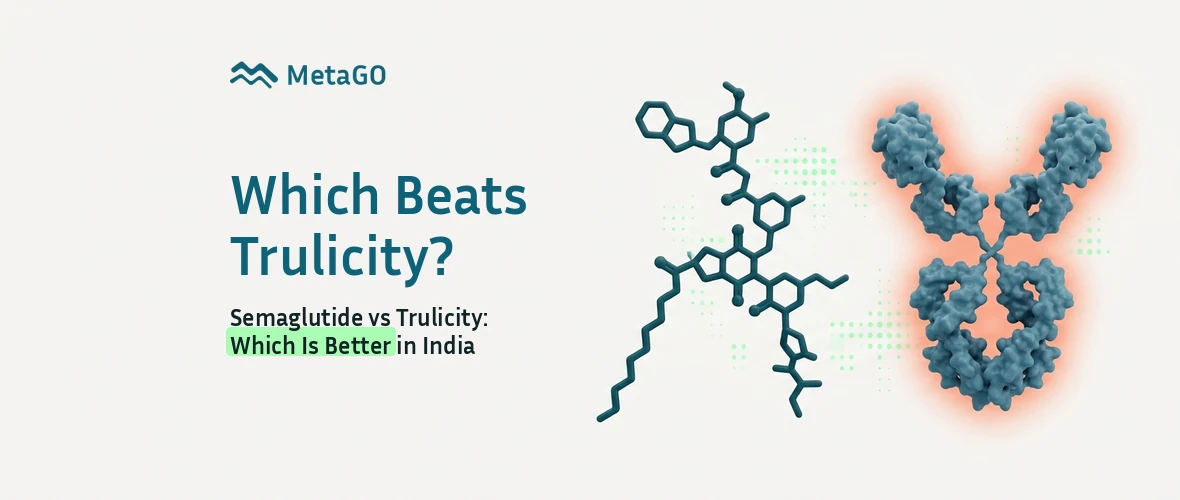
Despite sharing this core mechanism, the two drugs differ significantly at the molecular level. Semaglutide has 94% structural homology to human GLP-1, with modifications that extend its half-life to approximately one week through albumin-binding.
It is available as a once-weekly subcutaneous injection (Ozempic) or a once-daily oral tablet (Rybelsus).
Dulaglutide achieves its once-weekly dosing through a different strategy: its GLP-1 analogue is fused to a modified human IgG4 antibody Fc fragment, which slows renal clearance.
These molecular differences translate into meaningful real-world distinctions in potency, tolerability, and flexibility, which the sections below cover in detail.
Table 1: Drug Overview at a Glance
| Feature | Semaglutide (Ozempic / Rybelsus) | Dulaglutide (Trulicity) |
|---|---|---|
| Manufacturer | Novo Nordisk | Eli Lilly |
| Drug class | GLP-1 receptor agonist | GLP-1 receptor agonist |
| Available forms | Subcutaneous injection + oral tablet | Subcutaneous injection only |
| Injection frequency | Once weekly (injection); once daily (oral) | Once weekly |
| FDA approved for | Type 2 diabetes (Ozempic, Rybelsus); obesity/overweight (Wegovy) | Type 2 diabetes; CV risk reduction in T2D |
| India availability | Ozempic, Rybelsus, and 40+ DCGI-approved generics | Trulicity (Eli Lilly), prescription-only |
| Half-life | ~1 week | ~5 days |
2. How Are They Dosed? A Practical Look at Titration
Both medications follow a gradual dose-escalation schedule designed to minimise gastrointestinal side effects as your body adjusts.
Skipping the titration phase is one of the most common causes of early discontinuation, so understanding the schedule matters.
Semaglutide (Ozempic) Injection Dosing
Treatment begins at 0.25 mg once weekly for four weeks as an introductory dose. This dose has no therapeutic effect on blood sugar; it exists purely for tolerability.
After four weeks, the dose increases to 0.5 mg weekly as the first maintenance dose. Most adults remain at 0.5 mg or 1 mg. If additional glycemic control is needed, the dose can be escalated every four weeks to a maximum of 2 mg weekly.
Oral Semaglutide (Rybelsus) Dosing
Oral semaglutide starts at 3 mg once daily for 30 days, then increases to 7 mg daily. The maximum dose is 14 mg once daily. It must be taken on an empty stomach with a small amount of water (up to 4 ounces), with a 30-minute wait before eating, drinking, or taking other medications. Absorption is significantly reduced if taken with food or other liquids.
Dulaglutide (Trulicity) Dosing
Trulicity starts at 0.75 mg once weekly for at least four weeks. If additional glycemic benefit is needed, your doctor may increase the dose to 1.5 mg, 3 mg, or up to 4.5 mg weekly.
Notably, Trulicity can be injected at any time of day, with or without food, which many patients find convenient.
Table 2: Dosing Comparison at a Glance
| Parameter | Semaglutide (Ozempic) | Semaglutide (Rybelsus) | Dulaglutide (Trulicity) |
|---|---|---|---|
| Starting dose | 0.25 mg/week | 3 mg/day | 0.75 mg/week |
| First maintenance dose | 0.5 mg/week | 7 mg/day | 0.75–1.5 mg/week |
| Maximum dose | 2 mg/week | 14 mg/day | 4.5 mg/week |
| Administration route | Subcutaneous injection | Oral tablet | Subcutaneous injection |
| Food restriction | No | Yes (empty stomach required) | No |
| Injection pen type | FlexTouch multi-dose pen | N/A (tablet) | Single-use auto-injector pen |
| Dose escalation interval | Every 4 weeks | Every 30 days | Every 4 weeks |
3. Which Drug Lowers Blood Sugar More Effectively?
The most important head-to-head data comes from the SUSTAIN 7 trial, published in The Lancet Diabetes & Endocrinology in 2018.
This phase 3b randomised controlled trial enrolled 1,201 adults with type 2 diabetes on metformin across 194 sites in 16 countries, comparing semaglutide and dulaglutide at matched doses over 40 weeks.
The findings were clear: semaglutide was superior to dulaglutide at both dose levels for reducing HbA1c (the primary endpoint) and body weight (the confirmatory secondary endpoint).
At the high-dose comparison, semaglutide 1.0 mg reduced HbA1c by 1.8% versus 1.4% with dulaglutide 1.5 mg, with a statistically significant estimated treatment difference of -0.41%. At low doses, semaglutide 0.5 mg reduced HbA1c by 1.5% versus 1.1% with dulaglutide 0.75 mg (estimated treatment difference: -0.40%).
These findings were further supported by a 2025 systematic review and meta-analysis published in PMC, encompassing 16 studies and 5,997 patients, which confirmed semaglutide’s superior efficacy in reducing HbA1c and fasting blood glucose compared to dulaglutide.
Table 3: HbA1c Reduction: SUSTAIN 7 Head-to-Head Results
| Drug and Dose | HbA1c Reduction from Baseline | % Reaching HbA1c < 7.0% |
|---|---|---|
| Semaglutide 0.5 mg | 1.5% | 69% |
| Dulaglutide 0.75 mg | 1.1% | 52% |
| Semaglutide 1.0 mg | 1.8% | 79% |
| Dulaglutide 1.5 mg | 1.4% | ~67% |
Source: Pratley RE et al. SUSTAIN 7. Lancet Diabetes Endocrinol. 2018.
4. Which One Produces More Weight Loss?
Weight loss is one of the most talked-about benefits of GLP-1 receptor agonists, and the difference between these two drugs on this front is substantial.
In SUSTAIN 7, semaglutide produced roughly twice the weight loss of dulaglutide at matched doses. Patients on semaglutide 0.5 mg lost a mean of 4.6 kg versus 2.3 kg with dulaglutide 0.75 mg.
At higher doses, semaglutide 1.0 mg produced 6.5 kg of weight loss versus 3.0 kg with dulaglutide 1.5 mg. Both estimated treatment differences were statistically significant (p<0.0001).
The percentage of patients achieving clinically meaningful weight loss was also significantly higher with semaglutide: 44% of patients on semaglutide 0.5 mg reached 5% weight loss, compared with 23% on dulaglutide 0.75 mg.
At the higher dose, 63% on semaglutide 1.0 mg reached 5% weight loss versus 30% on dulaglutide 1.5 mg.
A real-world study published in the American Journal of Managed Care (2026) mirrored these findings. Semaglutide patients lost a mean of 15.98 kg over 52 weeks, compared to 4.93 kg with dulaglutide (p=0.001).
More semaglutide patients achieved at least 10% weight loss (31.7% vs 8.3%, p=0.001).
Importantly, a mediation analysis published in PMC (2020) confirmed that semaglutide’s superior weight loss was predominantly independent of nausea and vomiting.
The weight reduction was driven by genuine pharmacological effects, not simply by eating less due to feeling sick. For patients whose primary goal is medically supervised weight loss, explore the MetaGo weight loss program. For patients requiring even greater weight reductions, tirzepatide (Mounjaro), a dual GIP/GLP-1 receptor agonist now available in India, has demonstrated up to 20.9% body weight reduction in the SURMOUNT-1 trial, surpassing both semaglutide and dulaglutide.
Table 4: Weight Loss Comparison: Clinical Trial Data
| Drug and Dose | Mean Weight Loss | Patients Achieving ≥5% Loss | Patients Achieving ≥10% Loss |
|---|---|---|---|
| Semaglutide 0.5 mg (SUSTAIN 7) | 4.6 kg | 44% | ~15% |
| Dulaglutide 0.75 mg (SUSTAIN 7) | 2.3 kg | 23% | ~5% |
| Semaglutide 1.0 mg (SUSTAIN 7) | 6.5 kg | 63% | ~28% |
| Dulaglutide 1.5 mg (SUSTAIN 7) | 3.0 kg | 30% | ~10% |
| Semaglutide real-world (52 wks) | 15.98 kg | 51.7% | 31.7% |
| Dulaglutide real-world (52 wks) | 4.93 kg | 25.0% | 8.3% |
5. What About Heart Health? Comparing the Cardiovascular Evidence
Both semaglutide and dulaglutide have demonstrated significant cardiovascular benefits in large dedicated outcomes trials, which is a major reason why cardiometabolic guidelines increasingly favour GLP-1 receptor agonists for patients with type 2 diabetes and elevated cardiovascular risk.
Semaglutide: SUSTAIN 6 and PIONEER 6
The SUSTAIN 6 trial, published in the New England Journal of Medicine, enrolled 3,297 patients with type 2 diabetes at high cardiovascular risk.
Semaglutide-treated patients had a statistically significant 26% lower risk of the composite primary outcome (cardiovascular death, non-fatal myocardial infarction, or non-fatal stroke) compared with placebo.
This reduction was driven primarily by a 39% decrease in non-fatal stroke and a 26% decrease in non-fatal myocardial infarction (the latter not statistically significant on its own).
Oral semaglutide was subsequently evaluated in the PIONEER 6 trial, which confirmed a cardiovascular safety profile consistent with its injectable form.
Dulaglutide: REWIND
Dulaglutide’s cardiovascular outcomes were assessed in the REWIND trial (Researching Cardiovascular Events with a Weekly Incretin in Diabetes), published in The Lancet in 2019.
This double-blind, placebo-controlled trial enrolled 9,901 patients and demonstrated that dulaglutide 1.5 mg significantly reduced MACE by 12% (HR 0.88, 95% CI 0.79–0.99, p=0.026).
A notable feature of REWIND: 68.5% of participants had no prior cardiovascular disease, making these findings particularly relevant for patients with cardiovascular risk factors rather than established disease.
Comparing the Two Indirectly
A population-adjusted indirect comparison published in PMC (2021) estimated that semaglutide was associated with a nonsignificantly greater reduction in MACE versus dulaglutide (HR 0.74, 95% CI 0.54–1.01).
No direct head-to-head cardiovascular outcomes trial has compared semaglutide and dulaglutide, so this indirect comparison should be interpreted with caution.
Both drugs are approved in India and globally for cardiovascular risk reduction in adults with type 2 diabetes who have established cardiovascular disease or multiple risk factors.
Always discuss your specific cardiovascular risk profile with your doctor before making a treatment decision.
6. Side Effects: What to Expect with Each Drug
Because both drugs work through the same GLP-1 mechanism, their side-effect profiles are broadly similar.
The most commonly reported adverse events for both are gastrointestinal in nature.
Table 5: Common Side Effects Comparison
| Side Effect | Semaglutide | Dulaglutide | Notes |
|---|---|---|---|
| Nausea | Most common; up to 20–30% of patients | Most common; up to 20–30% of patients | Usually mild-to-moderate; peaks in first 8–12 weeks |
| Vomiting | Less common; dose-dependent | Less common; dose-dependent | Generally resolves with titration |
| Diarrhoea | 10–15% of patients | 10–15% of patients | Tends to improve over time |
| Constipation | Reported; more common with semaglutide | Reported | Dietary fibre and hydration may help |
| Decreased appetite | Common; contributes to weight loss | Common | Desirable effect for most patients |
| Hypoglycaemia | Low risk (unless combined with insulin/SU) | Low risk (unless combined with insulin/SU) | GLP-1 action is glucose-dependent |
| Injection site reactions | Generally mild and transient | Generally mild and transient | Rotate injection sites |
| Heart rate increase | Mild increase reported | Mild increase reported | Typically not clinically significant |
| Thyroid risk (preclinical) | Black-box warning (rodent data only) | Black-box warning (rodent data only) | Avoid in patients with MTC or MEN 2 |
| Pancreatitis | Rare; monitor for symptoms | Rare; monitor for symptoms | Discontinue if suspected |
One practical difference: because oral semaglutide (Rybelsus) is absorbed across the stomach lining, it requires fasting administration, which some patients find inconvenient.
Both injectable forms can be taken at any time of day with or without food.
Talk to your doctor before starting or changing any GLP-1 receptor agonist, particularly if you have a personal or family history of medullary thyroid carcinoma (MTC), multiple endocrine neoplasia type 2 (MEN 2), or pancreatic disease.
7. Semaglutide vs Trulicity: Availability in India
The GLP-1 receptor agonist market in India has expanded rapidly. Both semaglutide and dulaglutide are available across major cities and can be accessed through hospital pharmacies and qualified endocrinologists.
Semaglutide in India
Semaglutide is available in India through multiple forms and brands. Ozempic (injectable) and Rybelsus (oral) are the innovator products from Novo Nordisk.
Following patent expiry in March 2026, over 40 DCGI-approved generic semaglutide brands have entered the market, including products from Natco, Alkem, Dr. Reddy’s, Zydus, Sun Pharma, and Glenmark.
All formulations are Schedule H (prescription-only). The oral form (Rybelsus) is approved in India specifically for type 2 diabetes management.
Dulaglutide (Trulicity) in India
Trulicity by Eli Lilly is accessible via endocrinology clinics and hospital pharmacies in major metropolitan centres. It is a prescription-only product. A generic version is not expected before 2027, when Trulicity’s patent expires globally.
Both drugs are in the India GLP-1 receptor agonist market, which was valued at approximately USD 150.8 million in 2025 and is projected to grow at a compound annual growth rate of 22.7% through 2033, driven by rising prevalence of type 2 diabetes and increasing clinical adoption of incretin-based therapies.
| The Bottom Line |
| Semaglutide and dulaglutide are both effective GLP-1 receptor agonists with proven glucose-lowering and cardiovascular benefits. The clinical evidence consistently shows semaglutide produces greater HbA1c reduction and approximately twice the weight loss compared to dulaglutide at matched doses. |
| Dulaglutide remains a well-tolerated, clinically meaningful option, particularly for patients who respond to its dosing flexibility or for whom Trulicity is the first available GLP-1 in their clinical setting. |
| The best drug is the one your doctor recommends based on your HbA1c target, body weight goals, cardiovascular risk profile, and individual tolerance. Speak with a qualified endocrinologist or diabetologist before making any treatment decision. |
Frequently Asked Questions
Is semaglutide (Ozempic) stronger than Trulicity (dulaglutide)?
Based on direct head-to-head evidence from the SUSTAIN 7 trial, semaglutide produces statistically greater reductions in HbA1c and approximately twice the weight loss compared with dulaglutide at matched dose levels.
That said, both drugs are clinically effective, and individual response can vary. Your doctor will select the most appropriate option based on your treatment goals and health history.
Can I switch from Trulicity to semaglutide?
Switching from dulaglutide to semaglutide is clinically feasible and is commonly done when greater HbA1c or weight loss benefit is needed.
Typically, semaglutide is started at the next scheduled dose time after dulaglutide is discontinued. Speak with your prescribing physician before switching any GLP-1 receptor agonist, as dose titration and monitoring requirements apply. For a detailed breakdown of how the two drugs compare head-to-head, see our Ozempic vs Trulicity guide.
What is oral semaglutide (Rybelsus) and how does it compare to Trulicity?
Rybelsus is the oral tablet form of semaglutide. While it offers needle-free convenience, it has strict administration requirements (empty stomach, small amount of water only, 30-minute wait before eating).
In clinical trials, oral semaglutide at 14 mg demonstrated HbA1c and weight reductions broadly in line with injectable semaglutide at 0.5 mg.
Trulicity is injectable only and has no food restrictions. Your doctor can advise which form best suits your lifestyle and clinical profile.
Do both semaglutide and dulaglutide reduce the risk of heart attack and stroke?
Yes. Both drugs have demonstrated significant cardiovascular benefit in large outcomes trials.
Semaglutide reduced MACE by 26% versus placebo in the SUSTAIN 6 trial (NEJM). Dulaglutide reduced MACE by 12% versus placebo in the REWIND trial (The Lancet).
These benefits are relevant for patients with established cardiovascular disease and those with cardiovascular risk factors.
Are there GLP-1 receptor agonist options available in India for type 2 diabetes?
Yes. Both semaglutide and dulaglutide are available in India on prescription. Semaglutide is available as Ozempic (injectable), Rybelsus (oral), and over 40 DCGI-approved generics from Indian manufacturers since March 2026.
Dulaglutide is available as Trulicity by Eli Lilly. Speak with an endocrinologist or diabetologist to determine which option is right for your condition.
| Medical Disclaimer: This article is for informational and educational purposes only. It is not intended to replace professional medical advice, diagnosis, or treatment. Always consult a qualified healthcare professional, such as a licensed endocrinologist or diabetologist, before starting, stopping, or changing any medication. Individual treatment decisions should be made in consultation with your doctor based on your complete clinical history. |