
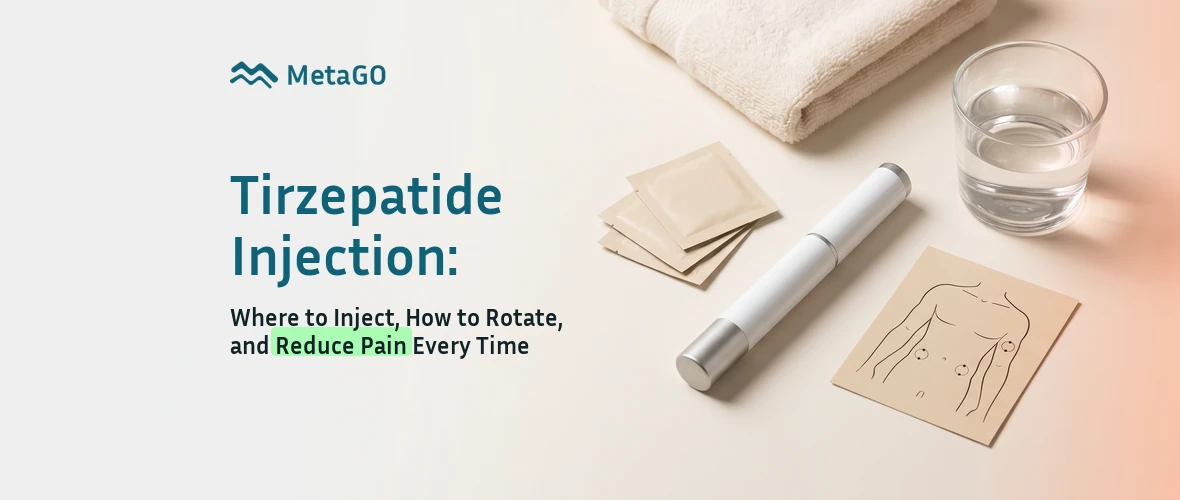
| Key Takeaways |
| • Three approved sites: Tirzepatide may be injected into the abdomen, outer thigh, or upper arm. Each site works, and rotating between them is what keeps your skin healthy. |
| • Rotate every dose: Injecting in the same spot repeatedly can cause hard lumps under the skin (lipodystrophy), which may affect how the medication is absorbed. |
| • Most reactions are minor and temporary: Clinical trial data from the SURPASS programme shows that injection site reactions occur in roughly 3 to 7% of users. The majority resolve within a few days on their own. |
Starting a once-weekly injectable medication raises a lot of practical questions. Knowing exactly where to inject, how far to move each time, and what to do when your skin protests makes the process far less stressful.
This guide covers all of it, step by step. For background on how tirzepatide works in the body, that context is worth a read before your first dose.
1. Which Body Parts Can You Actually Inject Tirzepatide Into?
Tirzepatide is a subcutaneous injection, meaning it goes into the fatty tissue just below your skin, not into a vein or muscle.
According to the official U.S. FDA prescribing information for Mounjaro and Zepbound, there are three approved injection sites: the abdomen, the thigh, and the upper arm.
| Injection Site | Exact Location | Best For | Watch Out For |
|---|---|---|---|
| Abdomen | At least 2 inches (5 cm) away from the navel; avoid the beltline area | Easiest self-injection; most accessible | Avoid areas with scars, stretch marks, or waistband pressure |
| Outer Thigh | Upper outer quadrant; start 3 finger-widths above the knee, one hand-width below the hip | Good alternative if abdomen is irritated; easier to see | Avoid the inner thigh (higher density of surface blood vessels) |
| Upper Arm | Back or outer surface of the upper arm, in the fleshy area | Useful for variety in rotation | Harder to self-inject; consider having a caregiver assist |
One question that comes up often: does the site you pick affect how well the medication works? The short answer is not in a clinically meaningful way.
A pharmacokinetic study published in Diabetes, Obesity and Metabolism found minor absorption differences between the abdomen, thigh, and upper arm for subcutaneous GLP-1 receptor agonists, but these differences were not considered clinically relevant.
What matters far more is that you rotate sites consistently and use correct technique each time.
2. Why Rotating Your Injection Site Is Not Optional
Rotation is one of the most important habits to build with any long-term injectable medication. Injecting repeatedly into the same spot causes a condition called lipohypertrophy (or lipodystrophy), where the fatty tissue under the skin hardens and thickens over time.
Once this happens, absorption from that area becomes unpredictable.
A review published in Lipodystrophy: Still an Underdiagnosed Complication of Subcutaneous Administration in PMC (NCBI) described a patient whose medication became consistently under-absorbed after she developed lipodystrophy at her preferred injection points, because the hardened tissue felt painless and she had unknowingly been favouring it.
A practical rotation map helps prevent this entirely.
The Zone-Based Rotation System
Think of your injection sites as separate zones, and move between them in an organised pattern.
| Zone | Sites Available | Rotation Rule |
|---|---|---|
| Abdomen | Left side and right side of the navel (2 sub-zones) | Move at least 1 inch (2.5 cm) from the last injection within the same side |
| Thigh | Left thigh and right thigh (2 sub-zones) | Alternate legs; stay in the outer quadrant |
| Upper Arm | Left arm and right arm (2 sub-zones) | Use when abdomen and thigh are recovering |
That gives you up to 6 distinct sub-zones to cycle through. With a once-weekly injection, you can give each spot at least 5 to 6 weeks to recover before returning to it.
This is more than enough time for tissue to heal completely.
One important detail: never inject into skin that is red, bruised, tender, hard, or has visible lumps. If you feel a firm area under the skin at a previous injection site, avoid that spot entirely and let it recover.
3. Step-by-Step: How to Inject Tirzepatide Correctly
Correct technique reduces discomfort, minimises the chance of reactions, and ensures the full dose reaches the subcutaneous layer where it belongs.
The steps below are consistent with the Instructions for Use included with Mounjaro and Zepbound as filed with the U.S. FDA.
- Remove the pen from the refrigerator 30 minutes before your injection. Cold medication is thicker and can sting more. Bringing it to room temperature reduces discomfort noticeably. Do not use a microwave, hot water, or any heat source to warm it.
- Wash your hands thoroughly with soap and water for at least 20 seconds.
- Choose your rotation site based on your last injection. Check the area visually and with your fingertips. Avoid any spot that is tender, discoloured, or has a lump beneath the surface.
- Clean the skin with an alcohol swab and allow it to dry completely for 10 to 15 seconds. Injecting through wet alcohol can cause a brief stinging sensation.
- Pinch the skin gently if you are injecting into the abdomen or thigh. This lifts the subcutaneous fat layer and reduces the chance of an intramuscular injection.
- Insert the needle at a 90-degree angle in a single smooth motion. Hesitating and moving slowly increases discomfort.
- Press and hold the injection button. The Mounjaro and Zepbound KwikPen requires you to hold the button down until the yellow indicator fills the window. Keep the pen in place for at least 5 to 10 seconds after the dose is complete before withdrawing.
- Withdraw the needle in the same straight angle. Do not rub the skin afterward. Light pressure with a clean cotton ball is fine if there is minor bleeding.
- Dispose of the used pen safely in a sharps container. Do not recap or reuse.
4. Why Does Your Injection Site React? (And What Is Normal)
Some degree of local reaction after an injection is a normal immune response.
When the needle breaks the skin and the medication enters the subcutaneous tissue, the immune system may release inflammatory mediators such as histamine and cytokines, producing a mild, localised response.
According to FDA prescribing information for Mounjaro, injection site reactions were reported in 3.2% of Mounjaro-treated patients versus 0.4% in the placebo group across pooled placebo-controlled trials.
What Does a Normal Reaction Look Like?
| Reaction | Appearance | Typical Duration | What to Do |
|---|---|---|---|
| Redness (erythema) | Pink or red skin around the site; may appear purple or brown on deeper skin tones | 24 to 48 hours | Cool compress; no action usually needed |
| Mild swelling | Small raised area at the injection point | 1 to 3 days | Cool compress; monitor for spread |
| Itching (pruritus) | Localised itch, may worsen for a few hours then ease | 1 to 2 days | Oral antihistamine (consult your pharmacist) |
| Bruising | Small discolouration from minor capillary damage | 3 to 7 days | Light pressure immediately after; let it resolve naturally |
| Soreness | Tenderness to touch at the injection point | 1 to 3 days | Avoid re-injecting that exact spot |
When Should You Actually Call Your Doctor?
Most reactions are minor and clear up on their own. Contact your healthcare provider if:
- Redness, swelling, or pain spreads beyond the immediate injection site or continues past 7 days
- You develop hives, facial swelling, difficulty swallowing, or shortness of breath, which may signal a systemic allergic reaction requiring emergency care
- A hard lump persists for more than 2 to 3 weeks at any injection site
- You notice skin discolouration or tissue changes that concern you
5. Six Evidence-Based Ways to Reduce Pain and Redness
Most discomfort from tirzepatide injections is manageable with technique adjustments. The strategies below are drawn from FDA prescribing guidance, clinical injection technique literature, and the SURPASS clinical trial programme data.
1. Bring the Pen to Room Temperature
This is the single most effective way to reduce injection pain. Cold medication creates more resistance as it enters tissue and can feel noticeably sharper.
Remove the pen from the refrigerator 30 minutes before your scheduled injection. Never use heat to speed this up.
2. Let the Alcohol Dry Completely
Injecting through alcohol that has not dried can cause a brief burning sensation. Wait 10 to 15 seconds after wiping the skin before inserting the needle.
3. Inject Slowly and Steadily
Pressing the pen button quickly forces a larger bolus of fluid into the tissue in a short period, which increases local pressure and discomfort. Hold the button down steadily and allow the full dose to dispense.
After the indicator confirms delivery, hold the pen in place for 5 to 10 seconds before withdrawing. This reduces medication backflow, which can also cause a localised reaction.
4. Stay Strict About Site Rotation
Re-injecting into an area that has not fully recovered is one of the most common causes of cumulative irritation.
A review published in the journal Children and discussed in PMC (NCBI) found that 44.3%of patients in one cohort had at least one lipodystrophy lesion, with failure to rotate being a primary contributing factor.
The zone-based rotation system from Section 2 above is the most reliable way to prevent this.
5. Avoid Problem Skin Areas
Never inject into skin that is bruised, red, scarred, stretched with visible striae, or that has existing lumps beneath the surface.
These areas have altered tissue architecture that increases both the chance of a reaction and the risk of unpredictable absorption.
6. Apply a Cool Compress Afterwards
If you experience redness or soreness after the injection, a cool (not ice-cold) compress applied for 5 to 10 minutes can reduce localised inflammation.
Do not apply ice directly to the skin. A clean cloth soaked in cool water works well.
6. Storage and Handling: What You Need to Know Before You Even Inject
How you store and handle your tirzepatide pen affects both safety and injection comfort. Improper storage can degrade the medication before it even reaches your body.
| Scenario | Correct Action |
|---|---|
| Storing unused pens | Refrigerate at 36°F to 46°F (2°C to 8°C). Keep away from the freezer compartment. |
| After removing from fridge | Use within 28 days if kept at room temperature (up to 86°F/30°C). Discard after this window. |
| Preparing to inject | Remove from the fridge 30 minutes before injection to bring to room temperature. |
| Checking the medication | Inspect the pen window before injecting. The solution should be clear to slightly yellow with no visible particles. Do not use if cloudy or discoloured. |
| Dropped or damaged pen | Do not use a pen that has been dropped or shows visible damage. Contact your pharmacy. |
| Freezing | Never freeze. A frozen pen must be discarded, not thawed and used. |
7. How to Check Your Own Injection Sites for Early Warning Signs
Regular self-checks help you catch lipodystrophy or persistent reactions early, before they affect the medication’s performance.
The Italian Consensus Statement on Injection Technique published in Metabolites (MDPI) recommends examining injection sites regularly as part of good injection practice.
Perform a quick check before each injection. Here is what to look and feel for:
- Firm or rubbery texture under the skin where you have previously injected. This may indicate the beginning of lipohypertrophy. Avoid this area.
- Visible skin thickening or raised patches. These are signs that the tissue has been overused.
- Persistent redness or discolouration beyond 3 to 4 days after an injection. This warrants a conversation with your prescriber.
- Skin that feels painless compared to surrounding areas. Lipohypertrophied tissue can become hyposensitive, which is why patients unconsciously return to it. This is exactly what you want to avoid.
If you notice any of these signs, give the affected area at least 4 to 6 weeks of rest before using it again. Rotate to other sites during this period.
| The Bottom Line |
| • Tirzepatide may be injected into the abdomen, outer thigh, or upper arm. All three sites are clinically approved and deliver the medication effectively when used correctly. |
| • Rotating between sites every dose is not a minor suggestion; it is the single most important habit for avoiding long-term skin complications that can affect how well your medication is absorbed. |
| • Most injection site reactions are mild, localised, and resolve within a few days. Consistent technique, room-temperature medication, and proper rotation address the majority of them before they start. |
Frequently Asked Questions
Where is the best place to inject tirzepatide?
The abdomen is the most commonly used site because it is easy to access and has consistent subcutaneous fat coverage. The outer thigh and upper arm are equally valid.
What matters most is that you rotate between all three sites rather than using one exclusively, as confirmed in the FDA prescribing information for Zepbound and Mounjaro.
How far apart should tirzepatide injection sites be?
Move at least 1 inch (2.5 cm) away from your previous injection within the same body area. When rotating between body areas (abdomen to thigh, for example), you are already giving the previous site adequate recovery time.
Always avoid injecting into an area that still shows redness, swelling, or tenderness from a recent dose.
How do I reduce pain at the tirzepatide injection site?
The most effective strategies are: letting the pen reach room temperature for at least 30 minutes before injecting, allowing the alcohol swab to dry completely, injecting at a consistent 90-degree angle, and holding the pen in place for 5 to 10 seconds after the dose completes before withdrawing. Consistent site rotation also prevents cumulative tissue irritation, which is a common source of ongoing discomfort.
Is redness after a tirzepatide injection normal?
Yes. Mild redness (erythema) around the injection point is a common, expected response. According to the Mounjaro FDA prescribing information, injection site reactions occurred in 3.2% of treated patients in pooled clinical trials.
Most redness peaks within 24 to 48 hours and resolves without treatment. If redness spreads, persists beyond a week, or is accompanied by significant swelling or warmth, speak with your healthcare provider.
Can I inject tirzepatide in the same spot every week?
No. Repeated injections in the same location cause lipohypertrophy, a condition where subcutaneous fat hardens and thickens.
Research cited in PMC (NCBI) shows that injecting into lipohypertrophied tissue leads to erratic and unpredictable drug absorption, which may reduce the medication’s effectiveness.
Use the zone-based rotation system described in Section 2 to keep every site healthy over the long term.
| Medical Disclaimer: This article is intended for informational purposes only and does not constitute medical advice. Tirzepatide is a prescription medication. Always follow the instructions provided by your prescribing physician and the official Instructions for Use that come with your pen. If you experience an unexpected or severe reaction, contact your healthcare provider promptly. |